

Information for Funders
A Monthly Funder Briefing
Tribal Funding Review
What we are learning in the field, written from our perspective. Field intelligence on Native leadership, funding pathways, and philanthropy in Indian Country.
We’ve helped Tribal Nations and Native-led organizations see the funding opportunities. This is the other half of that work, helping funders see Native leadership, governance, readiness, and priorities just as clearly. We call it Dual Visibility, and it is where stronger relationships and better-informed investments begin.
Imagine a funding ecosystem where Tribal Nations and Native-led organizations can see every opportunity that fits their priorities, where funders can see the leadership, readiness, and work already underway in Indian Country, and where capital actually moves between the two. The Tribal Funding Registry is the infrastructure that makes that possible. We invite you to help us build it to scale, and be responsive to the ever evolving needs of the first Peoples of this land.
The Tribal Funding Registry is not a software product. It is fundraising infrastructure, capacity building, and hands-on technical support built and run by Native People, with no cost for every Tribal Nation and Native-led organization, and aligned with the CARE Principles for Indigenous Data Governance.
THE GAP
Why so little funding reaches Indian Country
For more than a generation, philanthropy has asked why so little of its giving reaches Native communities. The figure most often cited is less than half of one percent a year. It is the best estimate available, not a precise count, and if anything it overstates how much actually reaches Tribal Nations and Native-led organizations rather than the larger institutions that also serve Native people. The number has barely moved in decades.
The reasons are not capacity.
Part of it is measurement. Native Peoples do not fit the demographic categories philanthropy uses to count itself, and much Native-to-Native and Tribal giving moves through channels public datasets cannot capture. The philanthropy field is measuring something it cannot fully see.
Part of the problem is follow-through. Many institutions have committed to equity and Indigenous-led solutions, and the movement of dollars has not always matched the language. We are told, often, that philanthropy does not know how to reach the work being done on the ground.
Another issue is how the work gets sorted. Many Native-led organization's work is holistic, and often inter-connected. One organization may provide health, arts, education, language, conservation, housing, and economic opportunity at the same time, because that is how community works. Philanthropy tends to sort the work of our communities by issue areas that are pre-defined by a sector not created by us. An Indigenous-led proposal, whatever its subject, is often routed to a single Native or Indigenous track, frequently a smaller and separately capped one, rather than weighed alongside every other proposal in its field.
Increasingly this is built into the tools themselves. Search filters and AI assistants tag Native-led and Indigenous work as ‘specialized’ or segmented and return only the opportunities carrying that label, hiding the far larger data set and opportunities. In reality, Native-led organizations and Tribal Nations should be eligible for the funding any organization can pursue.
WHAT HELPS
What Tribal Nations and Native-led organizations need from funders
Native communities are under-invested, not under-prepared. Tribal Nations routinely manage multi-year federal grants with compliance, reporting, audits, and financial stewardship. The leadership and the systems are already in place.
What strengthens the work is multi-year commitments, general operating support, trust-based practices, and patience with internal timelines. A strong funding match can still pause because a Tribal entity needs Council authorization or internal review before submitting, or because one person is carrying programs, reporting, and community requests at the same time. These are ordinary realities in Indian Country and in rural communities, not signs of risk.
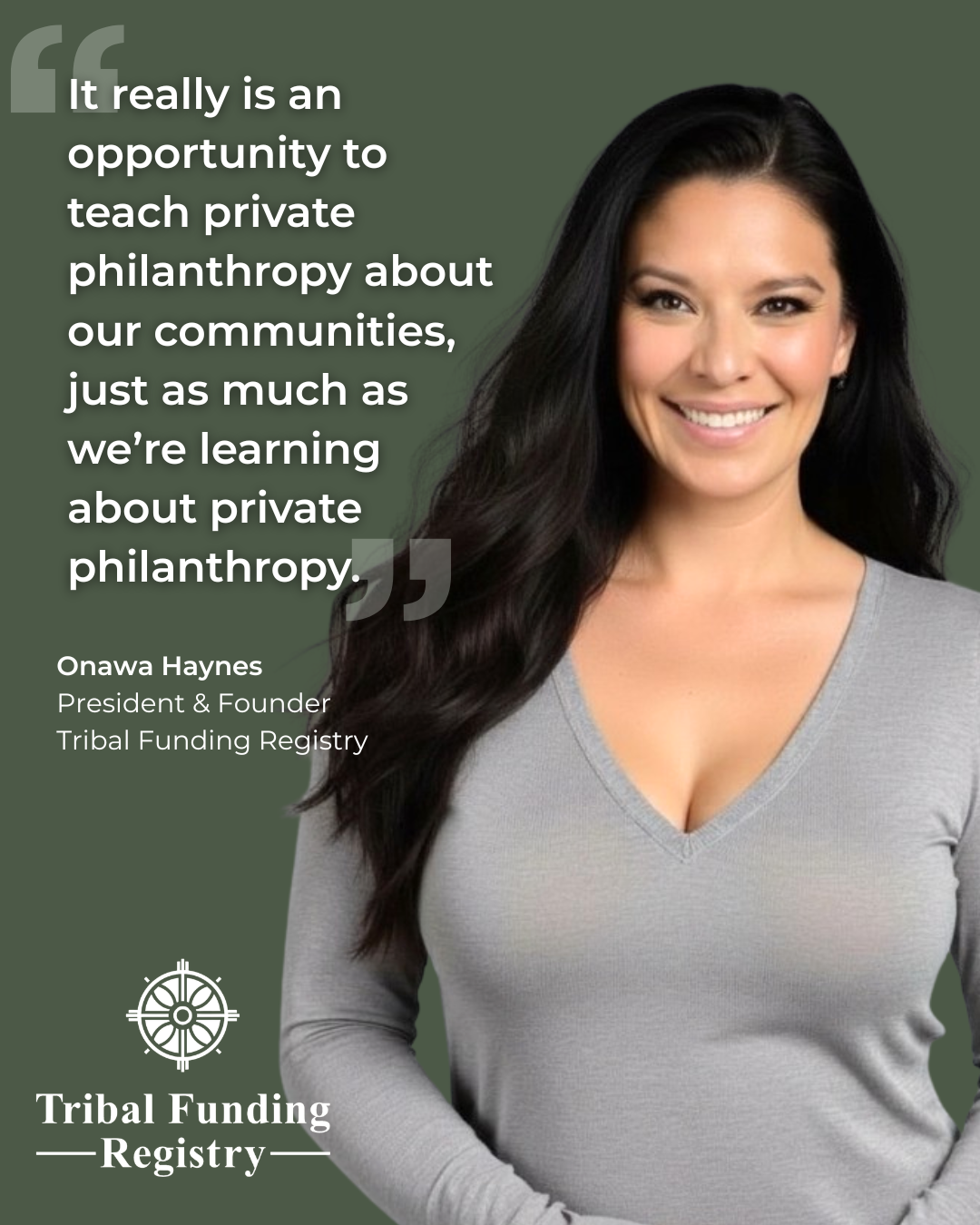
“When funders do not fully understand Tribal Nations, opportunities are missed. When Tribal Nations lack visibility into philanthropic systems, opportunities can be missed there as well. The result is a funding landscape where strong projects, capable leadership, and community-driven solutions are not always connected to the resources that could help move them forward… We sit with Tribal leaders, grant professionals, economic development directors, nonprofit executives, philanthropy leaders, and community advocates. We hear the questions being asked on both sides. We see misunderstandings, missed opportunities, and moments when understanding begins to emerge.”– Onawa Haynes, President & Founder, Tribal Funding Registry
And we want to share what we’re learning.
We are working to create greater understanding and lasting partnerships between philanthropy and Tribal Nations and Native-led organizations. We’ll share what we’re learning at the TFR, including insights into funding trends, the type of grants Tribal Nations and Native-led organizations want and need most, and some facts you may not know about Indian Country.
HOW FUNDING MOVES
How funding actually moves in Indian Country
Launched in March 2025, the TFR grew rapidly in its first year, reaching over 3,000 active users across 630 Tribal Nations, Native-led nonprofits, and Native-serving organizations in every region of the country. In its first year, TFR users built a grant pipeline of nearly $73 million in submitted proposals and secured just over $22 million in confirmed, self-reported awards. From working daily with Tribal Nations and Indigenous-led nonprofits, we’ve learned quickly how the work is resourced especially as major challenges have developed across multiple sectors- from philanthropy to federal funding.
Through our data and research, we’ve learned that funding in Native communities is usually braided from several sources: federal, foundation, state, private, and Tribal. Tribal funding, Native-to-Native giving among Nations, is a distinct source that often goes unseen by outside funders. A single Native-led organization may hold a 501(c)(3), a 501(c)(4), an LLC, a fiscal sponsorship, or a Section 7871 as a federally recognized Tribal Nation, sometimes several at once, to meet the needs of its people.
Federal funding is shaped by treaty and trust obligations, consultation, multi-year structures, and safeguards around sovereign information. Philanthropy tends to move through program officer relationships and more flexible language. Funders who understand how these pieces fit together make better-informed, more durable investments.
HOW WE WORK
Dual Visibility
The Tribal Funding Registry is funding discovery infrastructure for Tribal Nations and Native-led organizations, free in perpetuity. We call our approach Dual Visibility. Grant seekers gain a clear view of the funding picture. Funders gain a clear view of Native leadership, governance, readiness, and priorities. Stronger relationships and better-informed investments follow from that shared clarity.
Visibility never means surveillance. We do not ask Tribal Nations for sensitive financial information, and we do not track communities to satisfy outside curiosity. What we offer is curation, cultural attunement, and trusted relationships for both our philanthropic partners and Tribal Nations and Native-led organizations.

TALK WITH US
Start a conversation
If you fund this work, or want to understand it before you do, we would value a conversation. What changes outcomes is clearer visibility between philanthropy and Native communities, and the relationships that follow.
Or reach us directly at community@tribalfunding.org to start a conversation with our team.